Showing posts with label enigma. Show all posts

Saturday, November 14, 2020

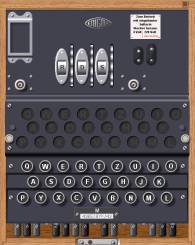
Arduino PicoEnigma Simulator

PicoEnigma
by @arduinoenigma

Arduino Enigma recently developed the tiny PicoEnigma, a universal physical Enigma simulator only 4 inch or 10 cm in size. He already made the Enigma Uno, Mega Enigma, Enigma Z30, and even build the Enigma Uhr switch for the plugboard.

Visit his PicoEnigma page for more details. The Arduino Enigma blog has the complete family of Enigma sims and many technical details on all projects. The circuit boards are found at Oshpark. Arduino Enigma is also on Youtube. The unique hand-made PicoEnigma and other types are available on eBay and on tindie.

Meanwhile, there's a race going on at the Enigma World Code Group forum to see who can build the smallest physical Enigma simulator. Incredible how they manage to build those tiny things. Just for fun, but technically true pieces of art.

I already wrote about his tiny touch screen Enigma Uno in 2014,  but he just couldn't stop creating different new versions in various sizes.

Visit Cipher Machines and Cryptology to learn everything about the fascinating Enigma cipher machine, how it was used by the German military during WWII and the Enigma Sim software for PC.

Saturday, February 08, 2020

Enigma Machine Project at Olin College

Libby Tawes, an engineering student at Olin College, contacted me in June 2018. She worked that summer as an intern at the Graveyard of the Atlantic Museum. Her major assignment was to research and design an exhibit about the Enigma machine. The museum displays the well known naval Enigma with serial M2946. Libby asked permission to use my Enigma simulator at the museum, but her work as an intern turned out far more interesting.

Her goal was to design an interactive visualisation of the Enigma. After trying some digital solutions, she decided that creating a physical replica of the encryption process would make the whole more approachable and engaging to a more broad audience. It is indeed challenging to understand the encryption process and electrical signals inside an Enigma machine. The final design idea was to demonstrate the encryption process in real time with electroluminescent wire that represented the Enigma rotors and their internal wiring. The fun and hands on interaction was met with excitement by museum patrons and directors.

When Libby's summer internship ended, she and the museum directors agreed that the exhibit would be put on hold and that she would continue to work on a prototype of the interactive Enigma if the opportunity presented itself. Her chance came when she returned that fall to her Principles of Engineering class at Olin College. The main object of the class was to build an electromechanical system.

When the project started, she was randomly assigned a team of five and proposed her interactive visualisation of the Enigma as the team's class project. Her teammates Dan, Bryce, Corey and Shyheim were enthused and they set off to build the interactive Enigma.

The Olin Team

Corey co-lead the electrical subteam with Bryce, who also contributed to the software subteam. Daniel was the lead for the mechanical subteam and also contributed to programming. Shyheim worked mainly in the mechanical subteam but also on CAD and programming. Libby, as resident mechanical engineer, contributed mainly to the overall organisation and in managing the team. After eight weeks of intense work they had created a operational version and posted their progress on a website.

You can visit The Enigma Machine project from the Olin team of engineers, but make sure to click all the "Learn More" links to discover all the nuts and bolts of their fantastic project. The Enigma Machine, A Fresh Take on an Historic Machine is an interactive visualisation project from the Principles of Engineering class at Olin College of Engineering. The class stimulates students to work as a team to design, construct and test electromechanical systems while learning development and production processes.

Enigma demo machine from the Olin team at the demo day

Libby's story is another wonderful example of how Enigma and its history can inspire young people. When she learned about the Enigma machine at the museum, she was not only inspired to visualise the machine's encryption process. She also tickled the interest of her team members to embark on a project that in turn is designed to interactively get others interested in Enigma and its history.

A resident student in a museum is all you need to turn seemingly boring subjects like cryptography and WW2 history into a fascinating project by engineering students. Or how history can spark the imagination of young people to become better students. That's why we document history and make it available at Cipher Machines and Cryptology. History is there to share!

The Enigma machine that inspired Libby comes with a fascinating story. Divers recovered Enigma M2946 in 2001 from the wreck of the German U-boat U-85. The destroyer USS Roper sunk U-85 by gunfire on April 14, 1942 in the North Atlantic near Cape Hatteras where the museum is located. U-85 was part of Operation Drumbeat (Unternehmen Paukenschlag) to attack American ships in their own coastal waters. U-85 was lost with all hands aboard. More about U-85 at the U-boat Archive. The Enigma is now displayed at the Graveyard of the Atlantic Museum.

More at my Enigma at School page.

Tuesday, December 09, 2014

Professor Brailsford on Enigma

Computerphile just published two talks by Professor Brailsford about the WW2 German Enigma cipher machine (edit: the third and final part is now published). He explains in an excellent and entertaining way how Enigma works and how it was broken, first by the Polish en then the British codebreakers in Bletchley Park. I believe it's one of the best videos I've seen on making codebreaking understandable. A must see! The talks are  made on the occasion of the release of The Imitation Game, a new movie about Alan Turing's work on Enigma. More detailed info on Enigma at these webpages.


Turing's Enigma Problem (Part 1) - Computerphile


Tackling Enigma (Turing's Enigma Problem Part 2) - Computerphile


Enigma, TypeX and Dad - Computerphile

Tuesday, November 04, 2014

Arduino Enigma Simulator

The Arduino Enigma simulator is a fantastic new simulation, running on the popular open source Arduino UNO platform. The electronics, based on the ATmega168 micro-controller, simulate the WW2 Enigma I, the Kriegsmarine M3, M4 and even incorporates the so-called Uhr switch to modify the plugboard connections.

The interface uses the small Seeed 2.8 Studio touch screen, making it probably the tiniest practical digital Enigma simulation. The maker used an interface structure with top view for operation, open lid for configuration and front view plugboard that resembles the Enigma Sim, providing a realistic hands-on approach.

Complete Enigma simulator with UNO board, touch screen and 9 volt battery

The Arduino Enigma was tested against fully compatible Enigma version and thus offers correct encryption. Its truly a pocket-sized Enigma, running on a small 9 volt battery.

You can find the Arduino Enigma project on tindie and discover additional project details and the required software at the developer's Arduino Enigma Simulator weblog. He even made a wooden Enigma case for his simulator. More information about the Arduino electronics is found on the Arduino website. Since a video can tell more than a thousand words, do check out the Arduino Enigma Demo video:


Saturday, March 23, 2013

OPERATION TURING

Story by Mitchel Thomas
Artwork by Indiana Popovich
In February, Mitchel Thomas and Indiana Popovich started a  unique project called OPERATION TURING. They are the first to blend a mysterious espionage story with the blistering pre-ware atmosphere of 1938 and encoded messages.

The British SIS, the American OSS and French DB have formed an Intelligence Task Force, code-named LABYRINTH, to identify the main threats to the Allies. Unfortunately, George Paxton, the original head of LABYRINTH, turned out to be a counter-intelligence agent of the German SS Sicherheitsdienst. One of the first priorities for the new head of LABYRINTH, SIS operative Peter Hansen, is to find Praxton and bring him to justice. Meanwhile, Paxton has his own agenda and forges some dark plans.

The story is cast into a weblog. After a brief introduction on OPERATION TURING, the reader is presented with various pieces of information: communications between the operatives by cable or radio, newspaper articles, photo's and Enigma encrypted messages. With each new blog post, a new bit of the hunt for Praxton and the battle between Allied and Nazi security services in unveiled.

Artwork by Indiana Popovich
The whole website breathes the atmosphere of shadowy operations in the pre-ware era. The images, black-and-white photos, old postcards, telegrams, maps and even 1938 PanAm flight tickets, combined with a beautiful art-deco background,  immerse you in that fascinating period at the brink of war.

I was pleasantly surprised to see a well brought and exciting story, where the Enigma messages play the smaller role, and not the other way around. Here, attention goes in the first place to the story-line, not to the tools to bring the story, and that's a great idea. Moreover, its a unique idea.

I can highly recommend a visit to OPERATION TURING, to absorb the story and atmosphere. Each new post brings new information in various forms. Often, there's and Enigma encrypted radio or cable message. The Enigma key sheets are provided and you can click your way to additional info and help. No codebreaking or cryptanalysis is needed, all settings to decipher the messages is provided.

However, being such a mysterious website, you should first continue reading here below, to understand how things work at OPERATION TURING. You might get lost in the fog of the shadowy world of intelligence and spies, when you're not 'in the picture'!

The newcomers on OPERATION TURING should first do some read-up before reading the episodes, published every few days. Warning: the most recent episode of the story is found first (weblog system). If you're new and want to start at the beginning of the story, you should go directly to the bottom of the main pages and click on the "=>Older" link your way through the blog pages to the oldest (first) message where the story begins.

There are three other pages that you can visit by links at the top of the page (under the green logo): You'll fist need a read-up at About Operation Turing to travel back to 1938 and to get familiar with the main characters. How to decode the messages provides the ways an tools to decipher the messages.

Transcripts and decoded messages is the spoiler page for those who really are unable to decrypt the messages (you should try, it's not that hard). However, only the decrypts of the previous month are provided. If you want to know right away how the story develops, you'll need to decipher the messages yourself. It does however pays off, as nothing beats the thrill of decoding a message and finally read its content. Finally, you can always go back to the main page by clicking the green logo (Enigma in circle).

Artwork by Indiana Popovich

I discovered the website by accident, as they linked to my Enigma software to enable decrypting some of the messages. However, the unique thing about OPERATION TURING is not the use of Enigma or some challenge to decipher encrypted messages. Enigma is merely a means to bring information to the reader. 

Mitchel and Indiana did a wonderful job on the story and the graphics. For the two friends, it all started years ago when they used coded messages to communicate, just for fun. A few years later, after graduation, they moved apart and brought the coded messages back to life to keep contact. To make thing interesting for themselves, they developed characters and a story-line which resulted in this jewel called OPERATION TURING.

I truly believe it deserves much more attention and readers than it was meant for. Their childhood pastime evolved into a unique and beautiful project. I'm sure Mitchel and Indiana will love your feedback (see their Inquiries link). Rendez-vous at the OPERATION TURING website... and watch your back!

A similar adventure is created at Cipher Machines and Cryptology. Operation Tinker Bell is the 1964 hunt for a KGB defector. Bookmark that page and get ready to track down your Cold War enemies!

Saturday, February 23, 2013

Enigma World Code Group

Ham radio operator Bruce Culp N7CLH just announced the launch of the Enigma World Code Group. The website is created for people who want to learn about the famous German World War II Enigma code machine and to use an Enigma simulator to exchange coded messages with other members and friends in the group.

Real Enigma cipher machines are very rare and expensive, found only in a few museums and in private collections. However, today, several fully compatible Enigma simulations are available as freeware download on the Internet. You can also use these simulators to decrypt authentic wartime messages, today available with the original message keys.

Using a WW II cipher machine to encrypt or decrypt messages sounds pretty complicated? Think again! Bruce and Terry Culp did an excellent job in creating a website that clearly explains step by step how to send Enigma encrypted messages.

Over time, more and more Enigma enthusiasts have started to send Enigma encrypted messages to each other: collectors do it for fun, students and teachers learn about Enigma at school and want to try it themselves, on U-boat computer game forums they communicate with each other during virtual U-boat missions, and anyone with a technical mindset loves the technology behind this ingenious machine. They all love to work with this fascinating piece of wartime cryto gear.

Thanks to the Enigma World Code Group (EWCG), you can now team up and send messages as if you were a German signals operator yourselve. You can generate your own code books or use EWCG's standard U-571 code books. Visit the Enigma World Code Group, join the group today and enter the world of WW2 encrypted radio messages! Fun guaranteed!

Friday, January 11, 2013

Enigma Challenge Update

The Enigma Simulator
William and Alice Thomas, two retired U.S. Navy cryptologists, successfully completed the Enigma Challenge on January 10, 2013 as a husband-and-wife team. They are the 38th to solve all ten messages. It was their love for WW2 history that drew them into this challenge and it was an honor for me to receive them in the challenge.

History is important to all of us, but especially to cryptologists, because it is by learning how crypto systems worked in the past that they can both improve their own systems and exploit those of the adversary. The history of the German Enigma machine, which played a major role in Second World War, is probably the most important example of cryptology and its power, and this initiated the extensive use of Signals Intelligence in modern warfare.

Meanwhile, the Enigma Challenge is running for almost seven years. Here are some statistics: in 82 months, 209 competitors from 35 different countries entered the challenge. I received 1278 correct message solutions (yes, that kept me busy :-). Until now, 18 percent of the participants solved all ten messages. Some worked day and night to solve the messages in only a few days. Others took weeks, months or even more than a year to finish the challenge, depending on their available free time and how much sleep they wanted to sacrifice.

47 percent correctly decrypted at least 7 messages, which shows that everyone with a bit of perseverance can get pretty far in this challenge. All kinds of people have entered the challenge: students, technicians, farmers, computer programmers, school teachers, writers, military, radio amateurs and many others. Their age ranged, as far as I know, from 12 to 85 years.

The statistics show that cryptology and codebreaking are quite popular. This always amazed me, since cryptology is often regarded as a boring and obscure science for geeks (just mention crypto to your neighbour and you know what I mean). However, the Enigma challenge and the number of visitors on my website proved the contrary. You don't need to be a genius or maths geek to enter the challenge and it’s really fun to do. Nothing beats the thrill of finally discovering readable text in a cryptogram.

I also found that my Enigma simulator is used by many teachers in high schools and universities to initiate their students in the world of ciphers and codes. Cryptology and the world of military secrets and intelligence is an exciting way to get young people interested in maths.

I'm pleased to see that the challenge continues to attract both young and old. Visit the Enigma Challenge page, including the table of honor, and discover the freeware Enigma simulator. More crypto related information and history at Cipher Machines and Cryptology. And don't forget... crypto is fun!

Friday, August 10, 2012

U-534 Enigma M4 Messages Cracked

Enigma M4
I just received sensational news from Michael Hoerenberg. He succeeded in breaking 12 authentic Kriegsmarine messages, recovered from the German WW2 U-boat U-534, which were encrypted with the notorious four-rotor Enigma M4 cipher machine.

U-534 is one of the very few U-boats that were either salvaged or survived the war. U-534 was sunk in May 1945 by a British bomber. When she sank, she took with her the secret documents and equipment that were used to encrypt their communications. During the salvage of the U-boat, some of the original message sheets were recovered and preserved.

At this moment, Michael already managed to recover the key settings to 12 of the 59 available messages with his M4 WinEnigma (Turingbombe) and TBreaker software (and 112 CPU cores). Images of the original recovered message sheets and their plaintext version are published on his website.

The  breaking of these messages is fantastic news for the crypto community and Michael's achievement cannot be underestimated! Original messages, enciphered with the Kriegsmarine Enigma M4 (a much complexer encryption than the three-rotor machines of the Wehrmacht) are extremely rare and deciphered M4 messages are truly unique.

We are looking forward to the coming results of the codebreaking project. Please visit Michael's website Breaking German Navy Ciphers for more information about the codebreaking, the software and the recovered messages.

U-534 in Birkenhead, England, 2007

U-534 is currently displayed in the U-boat Story museum in Birkenhead, England. More about U-534 at U-boat Net. For more information about the Kriegsmarine Enigma cipher machine, visit the Enigma page on my website, where you can also download the popular freeware Enigma simulator (which can be used to decipher the original U-534 messages with the dicovered key setting).

Update 1: Michael also made available Kapitänleutnant Hartwig Looks' war diary of  U-264, containing the 25 November 1942 message that was solved in the M4 Message Breaking Project (see also M4 Project on my website).

Update 2: More sensational news from Michael. He managed to decipher the famous message, sent to all U-boats, that announced Great Admiral Dönitz as successor of Hitler (after his suicide) as new Fuhrer of the Reich. The original message form, ciphertext and decrypts are found at this page, and more info at the page Degarbling the Dönitz Message.


Below a video of a part of the exhibition of U-534 in Birkenhead, UK, which also shows one partially and one completely recovered Enigma machine. Notice how well preserved all artifacts are.


Monday, December 05, 2011

Enigma Simulator Update

Santa Claus has brought to you a new - major - update of my Enigma simulator. After some 300.000 downloads of the sim worldwide (who said history and maths are boring?), I decided to create a last major update with ideas that have floated around in my head in recent years.

Since the Mayas predicted the end of the world in 2012, I took the opportunity to put the new sim in Santa's sock so that you can enjoy the little gizmo before we all go with a big bang in the next year. And the best of all... is free!

Screenshots of the new Enigma simulator: Enigma I, M3 and M4

What's new in this version? There's a major graphical revision with a different front cover and internal view for each of the Enigma models (Heer and Luftwaffe, Kriegsmarine M3 and M4). There are now two types of rotors (labelled with letters or numbers) and the plugboard is revised, with different layouts for the various models. The plugboard layout order is also changeable. The individual plugs are now visible on top view.

A new photo gallery is added, with new images that I shot from various Enigma machines. The new sound effects are recorded from a real enigma machine, there's a sound on/off option and the Auto Typing function is improved. Finally, the help file is re-written and expanded. I hope these are enough reasons to go see what Santa brought to you!

You can download the Enigma simulator 7.0 from my website. Any comments on the new version are most welcome through my website. Have fun!

M. Hamacher created a nice video showing the nuts and bolts of my Enigma simulator and explains the wartime procedure to encrypt messages.

Sunday, November 27, 2011

BREAK THE CODE!

A new codebreaking contest, called BREAK THE CODE!, is now on-line. The challenge is organised by the Polish state institutes Wielkopolska Region and the Office for War Veterans. The game starts on December 10, 2011, but the 3-person teams can already register to take part at this challenge.

The challenge is created to commemorate the Polish achievements in breaking the German Enigma cipher machine prior to the Second World War. The two best teams will play the finals in Poland. The trip is part of the prize, apart from electronic equipment. Only European citizens (Poland excluded) can compete for the prizes. Non-Europeans are also invited to enter the contest and will be included in the over-all game classification.

The information about how the game works and how to register is already available on the website. For each stage in the contest, a lecture, related to cryptography, will be published on the website. The first lecture, to make the teams familiar with codebreaking and the contest, is already available from the game control panel. For more information on this great initiative, please visit their website codebreakers.eu.

If you think you're up to the job, don't hesitate! Put together a team of three and register before December, 10, when the challenge starts.

Tuesday, July 20, 2010

KP4EU Enigma Video

Angel Saavedra (KP4EU) from Puerto Rico, one of the Enigma Challenge competitors, compiled a nice video about the Enigma Machine. The video is a tribute to the famous cipher machine and it even shows my Enigma software.

The radio Hams among us should take a pencil and paper as there's also a Morse message to copy. The message is Angel's way to say thanks for my Enigma Challenge and the Enigma simulator. Muchas gracias, Angel!


Thursday, April 22, 2010

Mind of a Code Breaker

On You Tube there's a great documentary video from NOVA called World War II Mind of a Code Breaker. It's the story of the British code breakers in Bletchley park and explains the vital role code breaking and Signals Intelligence played during the Second World War.

The documentary tells the story of the German Enigma and Lorenz cipher machines. Visit the playlist to see all episodes. It's a 12 part video (113 minutes), so take your time for it. It's well worth watching!


Tuesday, March 30, 2010

2012 Alan Turing Year

On June 23, 2012, it will be 100 years ago that Alan Turing was born in London. He played a vital role in the development of the modern computer, was an ace codebreaker and designer of the Turing bombe that broke encrypted German messages during the Second World War.

Turing went to study at King's College, Cambridge where he graduated in 1934 with first-class honours in Mathematics. From 1936 to 1938 he studied at Institute for Advanced Study, Princeton, New Jersey. He studied pure mathematical work, but also cryptology and he built an electro-mechanical binary multiplier. In 1938 he obtained his Ph.D. from Princeton. After Princeton he also started to work part-time with the Government Code and Cypher School (GCCS), the infamous British WWII codebreakers.

During the war he was the lead man on breaking German military message traffic. He designed the Turing bombe (later enhanced by Gordon Welchman), a device to crack Enigma messages by searching the right settings for a given piece of ciphertext and its presumed related plaintext. He also developed a Bayesian statistical technique to assist in breaking the German naval Enigma. The intelligence profit, gained from his code breaking successes, were a most vital advantage that ensured Allied victory in WWII.

After the war he worked at the National Physical Laboratory on the design of the ACE (Automatic Computing Engine) and presented a paper which was the first detailed design of a stored-program computer. In 1949 he became deputy director of the computing laboratory at the University of Manchester, and worked on software for the Manchester Mk1, one of the earliest stored-program computers. He continued to contribute to early computer development, mathematics and artificial intelligence.

Being homosexual, Turing was convicted in 1952 for alleged misconduct (homosexuality was not allowed by the law) and was given a choice between imprisonment or probation conditional on his agreement to undergo hormonal treatment. Turing's conviction also led to the removal of his security clearance, depriving him of his cryptographic consultancy work for GCHQ. On 8 June 1954, Alan Turing committed suicide by eating a cyanide poisoned apple. The man who saved countless lives with his code breaking during WWII and founder of modern computer science was let down by his country.

On 10 September 2009, British Prime Minister Gordon Brown released a statement describing Turing's treatment as appalling: "Thousands of people have come together to demand justice for Alan Turing and recognition of the appalling way he was treated. While Turing was dealt with under the law of the time and we can't put the clock back, his treatment was of course utterly unfair and I am pleased to have the chance to say how deeply sorry I and we all are for what happened to him ... So on behalf of the British government, and all those who live freely thanks to Alan's work I am very proud to say: we're sorry, you deserved so much better".

More information about the coming events to celebrate the Turing Year are found on the Alan Turing Year website. On this website you will also find a list of excellent resources regarding Alan Turing and his work.

Friday, December 18, 2009

Enigma Patents

Enigma Rotor in Patent
The Crypto Museum website has published a large number of original patents, related to the German Enigma cipher machine. These documents, dated from 1918 to 1923, show the development of the Enigma machine and contains a large number of detailed technical drawings. Electrical circuits, different types of ciphering wheels and various mechanisms to advance them, printing systems and much more.

Some of the patents were filed by German engineer Arthur Scherbius, others by firms such as Gewerkschaft Securitas of Berlin and Chiffriermaschinen AG, both related to Scherbius. However, similar patents were filed by firms in the United States, the Netherlands, France and the United Kingdom, some of them related to Germany based companies.

All patents are available in pdf format on Paul Reuvers' and Marc Simons' Crypto Museum Enigma patents page. More patents are found on Arthur Bauer's Foundation for German Communication.

Friday, August 21, 2009

Crypto Museum

Paul Reuvers and Marc Simons finally found the time to merge all their wonderful information and photos of cipher machines into a beautiful website.

The Crypto Museum website is a refreshingly new site with lots of information on many cipher machines such as the well known German Enigma, various Hagelins, the Swiss Nema, the American M-209, KL-7 and SIGABA, but also less known machines. The Swedish Transvertex, the Gretacoder, several crypto devices from Philips, Siemens and many many more.

You can view hundreds of superb and very detailed photos they took of these marvels. But there's more! They also collected information and took photos of spy radio sets, burst encoders and several direction finders. Some of these are true Cold War jewels. The site is still under construction, although the collection is quite impressive already. A Kits section, News section and a Shop are in the pipe-line. Paul and Marc are by the way the developers of the Enigma E, the electronic kit that works exactly like the real thing.

Good information on old crypto machines is rare, and good websites on these machines are hardly available (Jerry Proc is one of the few). The Crypto Museum website is therefore a unique initiative with an unmatched collection of high quality images. A true delight of the senses, molded into a well designed and synoptic website. I can only urge you to visit the Crypto Museum website. A must!

Their Crypto Index page, lists all available crypto equipment, but as I mentioned before, there's much more to discover. Now, go... go!

Wednesday, August 19, 2009

Enigma Challenge News

On August, 17, Martin Eklöf from Sweden was the 20th person to break all 10 messages of the Enigma Cipher Challenge. He did it in an incredible four days and used software he wrote himself (in C language) to crack the Enigma messages. Congratulations to Martin!

Meanwhile, the competition is running for more than three years now and no less than 126 brave codebreakers joined this challenge. New competitors keep entering the challenge. If you want to give it a try, don't hesitate. You don't require any professional crypto skills or be a math geek. Some logical thinking and a bit of persistence will do the job and gets you in the Table of Honor.

Monday, August 10, 2009

Enigma Mathematics

Naval Enigma M4
© Dirk Rijmenants
The German Enigma cipher machine is the best known example of an ingeniously designed encryption device that ultimately was a true disaster, as it proved to be the Achilles heel of the German forces. Their blind thrust in Enigma was partially based on the theoretical security of the machine, a truly astronomical 3 x 10114. There's an NSA paper (pdf) by Dr. A. Ray Miller on this theoretical number. It was absolutely impossible to perform an exhaustive search on a machine with so many possible variations, not even with today's computerpower.

But the German cryptologists were wrong. Deadly wrong! The Allied codebreakers did break it and intercepted and deciphered millions of German military tactical messages during the war, revealing many battle orders and plans, and thus changing the outcome of war.

In reality, a Wehrmacht (Army) Enigma machine had a practical security (number of possible different settings), of only 1.07 x 10²³. Now, this is still a huge number. To give you an idea of the size of the number 1.07 x 10²³, you need 1.5 x 10¹⁵ sheets of paper (0.0039 inch each) to make a stack from the Earth to the Sun and with 1.07 x 10²³ sheets you can build roughly 70,000,000 of these stacks! No wonder the German cryptologists believed it was secure.

However, the security of a crypto device is more than key sizes and numbers, theoretical security and having to search through all possible combinations. There's also a very good Cryptologia paper by Rebecca Ann Ratcliff on the misleading statistics on Enigma and how dangerous it can be to rely on such theoretical security.

On my website you can find all the facts and figures about Enigma's mathematical security.

Saturday, March 07, 2009

Paper Enigma Replika

Unless you're living on another planet, you probably have noticed there's a financial crisis. I can imagine that many people are dreaming of their own Enigma machine, but currently have more useful things to do with their money. The unfortunate among us could try out my freeware Enigma simulator, which looks and works like the real thing or Mike Koss' Paper Enigma. However, now there's also a paper Enigma that looks exactly like the real thing!

You can construct your own Enigma machine with only a color printer, scissors and a bit of glue. Go to the Paper Replika website download the pdf Enigma M4 Naval machine, print it out in color and put it together. That's it! You don't need stiff card paper, plain paper will do just fine. This is the perfect solution for those who always wanted an Enigma machine on their desk without paying their pants off.

It's very beautiful, with realistic colors and nice details like an opening lid, plugs, rotors that stick out, and even the typical M4 handles. With some patience and a sharp cutter, you'll be able to make a real beauty. If you donate $2.00 you can obtain a larger version without the website credits on the machine.

Sunday, October 26, 2008

Secret Messages

Siemens Geheimschreiber T-52
If you're interested in crypto machines, espionage equipment and the Cold War, there's a unique temporary exhibition called 'Secret Messages' at the Jan Corver Museum in the Netherlands. It is an unmatched collection of very rare cipher machines and radio equipment from the Second World War until today.

There are three beautiful Enigma machines, a Wehrmacht model, the notorious Kriegsmarine Enigma and as if an Abwehr (counterintelligence) Enigma isn't rare enough, they have a special pre-Abwehr model which is a crossing between the Enigma D and the later Abwehr type. But there's plenty more in the Museum. Two Russian Fialka cipher machines, various Hagelin models, a NATO M-190 and even the famous Siemens Geheimschreiber T-52 and a most rare SIGABA CCM. A dream for every Cipher machine lover!

They also have a great collection of WW2 clandestine and spy radios such as the B2 suit case radio. From the Cold War era they have a wide range of spy radios, from the American RS1 to recent Soviet Special Forces radios. Surveillance equipment, bug tracing devices and spy cameras. It's all there.

A unique collection and a must for all those who are interested in WW2 and Cold War clandestine and espionage communications and cryptography. They are very helpful in explaining all the equipment and give all visitors a personal guide tour in different languages. The museum can be visited each Saturday from 10.00 to 17.00 hr, at least until the end of the year. A phone call before your visit is a good idea. Update: due to its success, the exhibition is prolonged until at least the end of February 2009!

You can visit the Jan Corver website, with some great pictures of the exhibition, or download the press release (pdf). I can highly recommend a visit, it's a once-in-a-lifetime chance!

Friday, October 03, 2008

What If

Naval Enigma M4
What if the messages, encrypted with the German Enigma cipher machine, were never broken? What if the Germans realized their traffic was read by the Allies? It would have had devastating consequences if the code breakers in Bletchley Park were unable to break into the German naval radio traffic. Britain and Europe depended completely on the lifeline across the Atlantic.

All Signal Intelligence, gathered by codebreaking, was called ULTRA, and it was used with the utmost care to avoid the source being revealed. Action was never taken unless the ULTRA information was backed up by other sources. If the Germans would notice that their radio traffic was insecure, they would have changed to other encryption systems or improve the existing ones. They could keep their plans and strategies secret again, which would at least prolong the war for several years.

How would a Second World War until 1947 be like? Many more casualties, to begin with. Maybe no second front in the West against the Germans, occupied with fighting Russia. This might bring Nazi victory in the East. Britain could have fallen, without the crucial supplies over sea. If Hitler was still in power in 1947, would the US have used the atomic bombe on Berlin? Or would the Germans, inventive as they were, already have their own weapons of mass destruction?

Chris Andrew visited Bletchley Park and interviewed several veteran code breakers. It's an interesting view on how things would have been without the Bombe to break enigma traffic and without the Colossus computer to break the German High Command messages. Visit the BBC radio program What If and listen to the 30 minutes interview.