Showing posts with label WW2. Show all posts

Friday, September 27, 2024

Ralph Simpson on Cracking the Enigma

Ralph Simpson was speaker of the month at the California Historical Radio Society where he gave a talk on the early development of encryption devices. He focused on the Enigma cipher machine, its inventors and patents, and its use by the German military during the Second World War. He also explains why the machine was considered unbreakable, but eventually proved to be the Achilles' heel of the German armed forces during the Second World War.

Ralph had a career in the computer industry but also developed a passion for old cipher machines and their history. He is a respected member of the cryptologic history community and runs a website with a wealth of historical crypto devices and equipment for secret communications, all accompanied by technical details and relevant historical information. Be sure to visit his website Cipher History.

Thursday, June 06, 2024

Martin Gillow's Virtual Colossus and Other Machines

The Virtual Colossus
© Image Martin Gillow

The history of crypto equipment is quite fascinating, but diving into the archives, searching for historical publications, or collecting those old machines is not everyone’s cup of tea. Luckily, we have a community, dedicated to preserving the history of old crypto equipment, research the technical details, publish their history and operational use, and bring those old crypto machines back to life, either physically, which can be quite expensive, or virtually though software simulations.

Writing software that works exactly like the real crypto machine requires extensive study of the original machine, its mechanical and/or electrical properties, and many hours to write the software that reproduces the plaintext or ciphertext exactly like the original machine. However, you could take it one step further, and make a virtual three-dimensional machine where you can manipulate all components and encrypt, decrypt or break messages, just like the wartime operators.

Martin Gillow created a website with no less than ten 3D simulations. The virtual British Colossus machine is the first ever digital computer, developed in WW2 to break the German Lorenz SZ40/42 encrypted telex, of which he also created a virtual version. There’s also the virtual Enigma machine, and the Bombe that was used by the Bletchley Park codebreakers to decrypt the German Enigma messages.

Hagelin's U.S. M-209
© Image Martin Gillow
Also the British Typex machine and the U.S. M-209, developed by the renown Swedish engineer Boris Hagelin, have their 3D version. Moreover, the collection includes the ICT 1301 ”Flossie” second-generation computer, the E.R.N.I.E electronic random number generator, and the American crib dragging machine Dragon that helped to break the Lorenz messages.

Of course, the countless hours of work by Martin to research and study those machines, and write accurate 3D versions, is just enormous, and makes this 3D collection simply unaffordable… unless you just want to preserve and share the history of old crypto machines, and make the simulations available to everyone for free. A big Thank You to Martin for creating all those virtual machines, and for being part of that small community, dedicated to preserve cryptologic history.

Make sure to scroll all the way down his main page, to find all virtual 3D simulations and read the various tutorials on how to use them. Also click the relevant "find out more" buttons to learn about each machine and its history. Visit the Virtual Colossus website.
 
Highly recommended, and no better day than D-day to share Martin's work and commemorate all codebreakers.

Friday, February 12, 2021

Tracking Cold War Signals

Adcock four element antenna array
WWII Naval direction finding station
(source: Frontline Ulster)
The Cold War was also a war of signals. This battle comprised chatter over radio, Morse, data and technical signals. Eavesdropping on enemy communications and analyzing their technical signals was a vital part of that battle. However, to know where those signals came from was just as important.

Directional antennas find the bearing of a signal. Early simple loop antennas had to be turned mechanically to find the signal bearing. With two or more such antennas on different locations, the target is located at the crossing of those bearings, but it was a cumbersome task. Later, double loop antennas and Adcock antenna arrays with four elements improved performance, but many more special  direction finding (DF) antennas were built to locate signals, and some were quite extraordinary.

German Wartime Research

The Wullenweber antenna array
(source: FGCRT)
Significant progress was made during the Second World War by Dr. Hans Rindfleisch, who invented the Circularly Disposed Antenna Array (CDAA). Rindfleisch also headed the Communications Research Command of the German Navy, and together with Telefunken they developed his antenna array under the codename Wullenweber.

The first Wullenweber, build in Skibsby in northern Denmark, was designed as high-frequency direction finding (HF/DF) antenna array and operated in the 6-20 MHz range. The above drawing shows, at the top, the view of the antenna array and the reflector screen wires behind them (click image to enlarge)
 
First Wullenweber at Skibsby site
(source unknown)
The antenna consisted of 40 vertical radiator elements, each supported by a wooden structure and placed in a large circle, 120 m (392 ft) in diameter. Inside that circle was a reflector screen of wires, supported by 40 poles and arranged in a smaller circle, 105 m (344 ft) in diameter.

The Foundation for German communication and related technologies (main page) has a description of the Wullenwever (original spelling), including German Naval research on Wullenwever (pdf p11-20) and the Landsberg-Lech conference (pdf) with technical details and several photos of  the Skibsby Wullenweber site.

German Technology in Soviet Hands

Many German scientists were rounded up by US and Soviet forces in the final days of the war. Both were interested in this new CDAA technology, but the Soviets were the first to start building them in 1951 with assistance of German scientists.

The Soviets eventually build 31 CDAA's of various types and called them KRUG. They were placed in Russia, Warsaw Pact countries, Mongolia, Cuba, Vietnam and Burma. These KRUG stations tracked radio communications of US and NATO reconnaissance aircraft and nuclear bombers. GlobalSecurity has info and photos on Soviet KRUG antenna arrays.

The Global U.S. Antenna Network

One of the German antenna researchers was moved to the United States to assists in the development of a CDAA. The US version of the Wullenweber was the AN/FLR-9 antenna, nicknamed "Elephant Cage". The first was built in 1962 at the RAF Chicksands base in the UK, leased by the US Air Force.

FLR-9 at USASA Field Station Augsburg, Germany (source: US Air Force ISR)

The huge FLR-9 antenna had an outer diameter of 440 m (1,443 ft) and height 37 m (121 ft). A network of eight FLR-9 was constructed in Alaska, England, Germany, Italy, Japan, Philippines, Turkey and Thailand. This network could accurately locate HF signals anywhere on Earth, to track enemy airplanes, ships or ground based transmitters, but also to follow own or friendly targets.

The US Naval Security Group operated the AN/FRD-10, also a Wullenweber antenna but smaller than the FLR-9. Its outer diameter was 263 m (863 ft). A network of sixteen FRD-10's was located at coastal lines of the Pacific and Atlantic on US mainland and Alaska, Hawai, Puerto Rico, Canada,  Panama, Japan, Spain and Scotland.

More about the Wullenweber

FLR stands for Fixed Countermeasures Receiving. FRD stands for Fixed Radio Direction-finder (see JETDS designations). More about the FLR-9 on FAS and Freedom Through Vigilance Association (USAFSS). Navy Radio has details of the AN/FRD-10. There's a report on the dismantling of the AN/FLR-9 at Misawa air base in Japan and the decommissioning of Joint Base Elmendorf-Richardson in Alaska (video). See also locations of AN/FLR-9 antenna system at the Station Hypo website.

More on WWII direction finding at the RSS Secret Listeners website and on Frontline Ulster's WWII Aircraft Direction Finding in the UK.

The NSA video below explains the history and purpose of the FLR-9.

 
The American Forces Network Pacific gave a look inside Misawa’s FLR-9, build in 1962. The antenna was demolished in 2014.


More on Signals

Many different signals were sent, received and analyzed during the Cold War. Below some posts on this blog about Signals Intelligence (SIGINT), but there's much more to discover...

Visit also the Cold War Signals page about the battle over radio waves on our website

Saturday, January 02, 2021

The Cold War Vogelsang Twins

There are quite a few places in Germany called Vogelsang, but two of them became part of Cold War history. They were located on opposite sides of the Iron Curtain that divided Europe into East and West. Although both named Vogelsang, these military twins, located 550 km (340 mi) apart, were quite different, as twins often are, and one of them could deliver a serious nuclear punch.

Before the Cold War

The first Vogelsang, a place between the villages Einruhr and Gemünd in the Eifel National Park, is located 55 km (35 mi) southwest of the city Cologne (Köln) in Germany, and close to the Belgian border. Until 2006, this place was known as Camp Vogelsang, a military training area. The camp however first had a more sinister history.

The history of this Vogelsang twin starts in 1933. Adolf Hitler, then chancellor of Germany, decided to create four Ordensburgen, training centers for the offspring of the NSDAP (National Socialist German Workers Party).

By 1936, three NS-Ordensburgen were partly build and already in use. Ordensburg Krössinsee in Pomerania, Ordensburg Sonthofen in Allgäu and Ordensburg Vogelsang in the Eifel. The forth in Marienburg was never built. The first Vogelsang NS Junkers (cadets) arrived in 1936.

Ordungsburg Vogelsang (source: VoWo)

The Junkers were lectured, or rather indoctrinated, on Nazi ideology, race science and foreign policy, and they received intensive physical training. The nearby Walberhof airfield provided pilot training.

The Ordensburgen were to become the breeding ground for the future Nazi elite. Regular education in the Ordensburgen ended in 1939 when the Second World War broke out. Vogelsang Castle was handed over to the Wehrmacht and its Junkers drafted in the armed forces.

In the excellent video below you have a 360° view of Vogelsang and inside its buildings. Start the video and grab the video screen with your mouse to look around. The interview is in German, but you can select settings > subtitles > auto-translate and choose your language.

Ordensburg Vogelsang housed troops during the German 1940 western campaign and several fighter squadrons were stationed at Walberdorf airfield. From 1941 until 1944, Vogelsang housed several Hitler schools, and from 1944, military training was given to boys aged 15 to 16 from the Hitler Youth. Vogelsang was cleared in 1945 after Allied air strikes had destroyed several buildings.

Camp Vogelsang Training Area - West Germany

After WWII, Ordensburg Vogelsang was in the western part of divided Germany, officially known as the Federal Republic of Germany (FRG). The area was taken over by the British Army in 1946. They initially planned to destroy this symbol of National Socialism but eventually turned it into a 6354 hectares (63km² or 25 sq mi) training area.

The people of the nearby village Wollseifen were ordered to leave the area and the village was then completely destroyed (later rebuild as urban warfare training area). Between 1946 and 1950, the British rebuild the castle, heavily damaged by air strikes. The training area consisted of nine firing ranges and an infantry exercise area. The British handed over Vogelsang to the Belgian Army in 1950.

Belgian 2nd Lancers Rgt with M47 Pattons, Vogelsang 1962 (source: legerdienst)

After the creation of NATO in 1956, the Vogelsang training area was used for nearly five decades by the NATO countries Belgium, United Kingdom, United States, Canada, the Netherlands, Luxemburg, Germany and France.

Belgian insignia Vogelsang
source: Christophe Cobbaut

Parts of the training area were returned to the civilians in 1960, reducing the training area to 4200 hectares. Over the years, the Belgians restored damaged buildings and added new ones. Vogelsang could accommodate 2500 troops and was used extensively for military exercises until 2005, when the camp was handed over completely to the German government.

Since 2006, the facility is open to the public as Vogelsang Internationaler Platz, part of Eifel National Park. You can visit the camp, which has an exhibit about its history and Nazi documentation on Vogelsang. They also organise guided tours. Burg Vogelsang is a protected monument since 1989.


Eifel National Park Vogelsang today


Soviet Base Vogelsang - East Germany

The military twin of Camp Vogelsang was a Soviet base in Vogelsang near Zehdenick, 55 km (35 mi) north of Berlin, in former East Germany, officially known as the German Democratic Republic (GDR). Although less in size, this one had serious striking power.

Mural monument at the Vogelsang Soviet base (source: Johan van Elk)

After WWII, Vogelsang was still a small village in a vast and dense forest that was difficult to access. The Group of Soviet Occupation Forces in Germany - GSOFG (Rus. Группа советских оккупационных войск в Германии - ГСОВГ ) claimed 2,000 hectares of the forest and commissioned in 1952 the construction of a military base in Vogelsang. The construction of the base was planned, built and paid for by the East German government

Soviet Forces in Germany
The site gradually grew into a town with a population of 15,000 soldiers, their families and civilian personnel. The town included several barracks, medical facilities, shops, a theatre, gym and school, and was basically self-contained. Vogelsang became, next to Wünsdorf, the largest and most expensive garrison of the Group of Soviet Forces in Germany GSFG (Rus. Группа советских войск в Германии - ГСВГ )

The garrison housed the headquarters of the 25th tank division, 162nd tank regiment, 803rd Motor Rifle Regiment, 1702nd anti-aircraft missile regiment and the Tactical Missile Division.

In 1959, the Soviet theatre ballistic missile R-5 and R-5M Pobeda (Rus. Побе́да, NATO name SS-3 Shyster)  became the main strike weapons of the garrison. They carried a 300 kt thermonuclear warhead (20 x Hiroshima) that could reach all strategic targets in Europe. The R-5M missiles mainly targeted the PGM-17 Thor intermediate-range ballistic missiles in the United Kingdom. Less than a year later, the Soviets withdrew the R-5's.

From 1983, the TR-1 Temp (Rus, Темп-С, NATO name SS-12 Scaleboard) mobile theatre ballistic missiles with 500 kt warhead were stored in Vogelsang. Enough to raise hell across Europe.

All Russian troops, then called Western Group of Forces, withdrew in 1994 and the abandoned town and the military buildings were partly demolished. What remained of the military town is now gradually reclaimed by the forest, as shown in the aerial video of the base. 

Little was known about secret "object" Vogelsang, but gradually more details surfaced. At the Lenin in Vogelsang website are several memoirs of soldier Serik Kulmeshkenov (translation), Igor Platonov part1 & part 2 (translation part 1 & part 2), the son of an officer, and Colonel Zharky F.M. from the 25th division (translation),

In the documentary Lenin in Vogelsang, people recount how the Russians and East Germans lived together in Vogelsang and the nearby Zehdenick. You can first select English subtitles and then auto-translate English in your language.


Growing up on a Soviet base in the GDR is a podcast interview with Andrej, whose father was a lieutenant in the Soviet army. They lived in Wünsdorf, the largest Soviet base in the GDR, and also in Rudersdorf and Prenzlau. His story gives an inside view on everyday life of Soviet families in the GDR.

These stories make you realize that those Soviet military and families serving abroad were mostly people just like us, doing the same work, only other leaders and ideology. Cold War Conversations has more podcasts with personal stories.

Vogelsang vs Vogelsang

Although we cannot compare Camp Vogelsang training area with the Soviet Vogelsang base and its nuclear strike capabilities, we should consider the British occupation zone, which also included the Belgian Forces Germany, and the American and French occupation zones. These zones stretched from the western border of West Germany to the East German border. They too deployed nuclear missiles.

The MGM-1 Matador surface-to-surface cruise missiles, armed with nuclear warhead, were deployed in 1953 by the 1st Tactical Missile Squadron from Bitburg U.S. Air Base. These were withdrawn in 1962. Three U.S. Army battalions, stationed in Germany, and two German Air Force wings received Pershing 1a nuclear missiles in 1965, and by 1985, the U.S had 108 Pershing II missiles in Germany and 464 nuclear armed cruise missiles in Germany and neighbouring countries. More about the Bitburg and Hahn Air Bases in Germany, equipped with nuclear weapons, at the 38th Tactical Missile Wing.

And we didn't even mention the many unguided nuclear bombs, stored by both NATO and Soviet units on many locations in powder keg Germany, let alone the thousands of ICBMs, both fixed and mobile in the US and USSR. In the end, all occupation troops left Germany in the 1990s, fortunately without firing a single doomsday-shot. The last troops to leave were the Belgian Forces Germany in 2005. In hindsight, a bit weird that we slept like babies when stationed there.

Below additional information, many photos and videos from both Vogelsang twins. Non-english pages are provided with translation link.

Camp Vogelsang (former West Germany)

Soviet base Vogelsang (former East Germany)

Thursday, February 11, 2016

Castle Feuerstein Laboratorium

There are many stories, some more fiction than real, about mysterious Nazi laboratories in dark castle dungeons where SS scientists performed all kinds of occult experiments. The Nazi obsession with the Ahnenerbe or the elite Wewelsburg SS school and center for archaeological excavations are probably the most sinister real examples, portrait in pc games like Return to Castle Wolfenstein.

What if I told you that scientists, led by Dokter Oskar Vierling, worked in a secretive laboratorium called Castle Feuerstein. Sounds like a sequel to the Castle Wolfenstein game? Not quite! Burg Feuerstein, located in Ebermannstadt, close to Nürnberg (Eng. Nuremberg), was all but fiction. A physicist in a mysterious laboratorium, how could that possibly relate to crypto and intelligence? Here's how...

The Hunt for Science

Feuerstein was an important target of TICOM, a secret WW2 Allied project to capture German scientists and seize SIGINT stations,  cryptographic and communications equipment, just before Germany surrendered. The mission of TICOM (Target Intelligence Committee) was to collect as much as possible German science and technology, preferably before Soviet forces got their hands on it. To achieve this, TICOM sent fast-moving teams to pre-determined valuable locations inside the collapsing Germany, sometimes ahead of Allied troops.

Burg Feuerstein in Ebermannstadt

Is there a better way to hide a secret laboratorium than to build a typical Frankischen Schweiz style castle on top of a mountain in plain sight? It was so obtrusive that no one would suspect its purpose. Burg Feuerstein was built from scratch in 1941 by Dr Vierling with private funds. He was a physicist, electronics engineer and professor in high-frequency technology and electroacoustics. Laboratorium Feuerstein started its research in 1942 and developed experimental communications systems. At its peak, Feuerstein housed 200 staff and workers. TICOM only learned about Feuerstein's existence from decoded intercepts that referred to its research.

A Most Prolific Scientist

The scientists, led by Dr Vierling, worked on a variety of projects, including high speed transmitters for covert agents, receivers, wave traps, accurate filter design, speech scramblers, voice frequency spectrography, teleprinter cipher (crypto) attachments, improvements on cipher machines, a synchronisation system for the Lorenz SZ42 cipher teleprinter, acoustics and filter components for acoustic torpedoes, anti-radar coating for submarines, a night fighter control system, various frequency generators and an electronic calculator to solve sine and cosine equations. They were a busy bunch!

Dr. Oskar Vierling
Just before the German collapse, Dr Vierling was ordered to relocate his speech projects to Berchtesgaden in the Bavarian Alps and to destroy all other projects and equipment. Vierling, however, had other plans with his Feuerstein legacy. Once the Nazi's were off to Berchtesgaden with the speech equipment, he stored the most valuable equipment and plans in a large bomb proof walk-in vault, hidden behind a false wall in Feuerstein. There, he awaited the end of the war.

Vierling Safeguards His Future

Burg Feuerstein was used as a German Army hospital at the time the TICOM team arrived. They rounded up the scientists and Dr Vierling proved very willing to cooperate with TICOM. Vierling and his group rushed to restore the laboratory and continued their work on selected projects under control of TICOM investigators.

NSA's declassified AXIS SIGINT in WWII, Vol II, Notes on German High Level Cryptography and Cryptanalysis contains some interesting crypto related info. The Lorenz SZ-42c cipher teleprinter with synchronisation, named SK-44 and SK-45, would generate and send a continuous pseudo-random five-bit stream. The receiver mixed its identical stream, by XOR-ing, with the incoming stream, resulting in nothing to print, since (K ⊕ K) = 0. When sending a message, the plain teleprinter message was mixed into the stream. The receiver mixed, as usual, the received signal with its own stream, which results in cancelling out the stream and the original plain message being printed instantly, since (K ⊕ M) ⊕ K = M.

An eavesdropper would not know if or when the random stream contained an actual message or how long it was, thus effectively preventing traffic analysis. The U.S. Army Security Agency (ASA) suggested that analysis of the continuous mostly non-message-carrying pseudo-random stream, generated by the  SZ-42c, might compromise the machine's secret key settings. This would enable them to predict the stream and decipher all message that follow. The principle of continuous random stream was nevertheless brilliant and used in the 1950s on the more advanced U.S. KWR-37 JASON and KWT-37 Fleet Broadcast crypto system.

Speech scrambling research by Dr Vierling's team produced little result. In 1943, only Dr Vierling and Telefunken still worked on ciphony (encrypted voice) and from 1944 on only Dr Vierling. At war ends, Feuerstein's research on ciphony focused on synthetic speech, encrypted by triple wobbling. The speech was separated in eight frequency bands. These were encrypted in a three stage ring wobbling (shifting the frequencies up and down) where the stage was split in half and these halves wobbled separately. However, speech quality after de-wobbling was very bad and ASA considered the German scientists several years away from developing any usable ciphony.

Declassified Feuerstein Documents

More details about the Feuerstein laboratory and Dr Vierling's work is available in chapter VIII, page 37 (pdf p.39) from (Volume 8 Miscellaneous NSA) of NSA's declassified files on European Axis Signal Intelligence in World War II. The rebuild of the lab under control of TICOM is described the Interim Report on Laboratorium Feuerstein from the NARA archive. (first pages are double, start reading from page 5). Another excellent source is the TICOM Archive. These documents contain enough inspiration for a few Wolfenstein sequels.

The importance of Feuerstein for TICOM is shown in ASA documents. The Temporary Duty Report NSA of Mr William Friedman, the renowned U.S. cryptologist, is a resume of his tour in Germany from July to September 1945, in cooperation with TICOM. Vierling's Laboratorium, noted as important TICOM target, was one of the sites he visited in July 1945. NSA has a few more documents related to Dr Vierling.

Post-War Crypto and Intelligence Work

After the war, Prof Dr Oskar Vierling continued working at his 1941 established firm VIERLING GmbH but relocated to Ebermannstadt, a mere kilometer from Burg Feuerstein. He had quite a prolific career, developing crypto machines, covert radio transmitters, eavesdropping devices, radio direction finding and various measuring and test equipment. He worked for Organisation Gehlen (post-war West-German intelligence), its successor the Bundesnachrichtendienst (foreign intelligence), the Zentralstelle für Chiffrierwesen (central cryptologic service) and the Deutsche Bundespost. From the 1930s until the 1950s he was also an important pioneer in the development of electronic and electro-acoustic instruments.

Due to legal restrictions on crypto export, Dr Vierling sold the rights for his crypto equipment to Crypto AG's predecessor Hagelin Cryptos. NSA archives show that Dr Vierling developed crypto machines in cooperation with ASA and NSA, at least until 1953. See Crypto devices of VierlingASA loan Vierling device and purchase transistors for Vierling. These documents show that Vierling provided a crypto machine for analysis and ASA supplied transistors for Vierling's crypto experiments. Transistors were quite novel in 1953 and their use in crypto equipment pretty unique.

Vierling's firm is currently still located in Ebermannstadt. Today, Burg Feuerstein is a catholic youth center.

Tuesday, February 10, 2015

BAPCO 's Use of One Time Pads During WWII

Mounted camel guard at the refinery.
Source: BAPCO
The Bahrain Petroleum Company (BAPCO) was a Canadian subsidiary, founded in 1929 by the American Standard Oil of California (Socal) to run its operations at the Awali oil fields on Bahrain Island, at the inlet of the Persian Gulf.

BAPCO became a possible target of Axis forces when Britain declared war on Germany. In 1940, the Bahrain oil refinery was targeted by Italian bombers, forcing the Allies to strengthen Bahrain's defense. Bahrain, in 1943 still a British Protectorate, decided to implement a censorship on messages that were sent over commercial cable and wireless, to prevent disclosure of information that might be useful to the enemy.

This censorship, however, greatly restricted the communications and operations of BAPCO. The majority of their messages contained information about oil production, shipping, personnel and food supply. Those messages fell into three main categories: a) cables that could be sent in plain text without objection, b) security cables that contained information that, in conjunction with other information, might indirectly be useful to the enemy, and c) secret cables that would be of direct use to the enemy if intercepted, such as ship movements, especially oil tankers.

On April 4, 1943, Ward P. Anderson, the general manager and chief local representative of BAPCO, asked E. B. Wakefield, the British Political Agent in Bahrain, permission to encrypted their cables between the local branch and their New York office. This would allow them to send security related cables, at the same time respecting Bahrain's censorship. Anderson proposed a secret company code, superimposed (enciphered a second time) with a transposition cipher for added security.
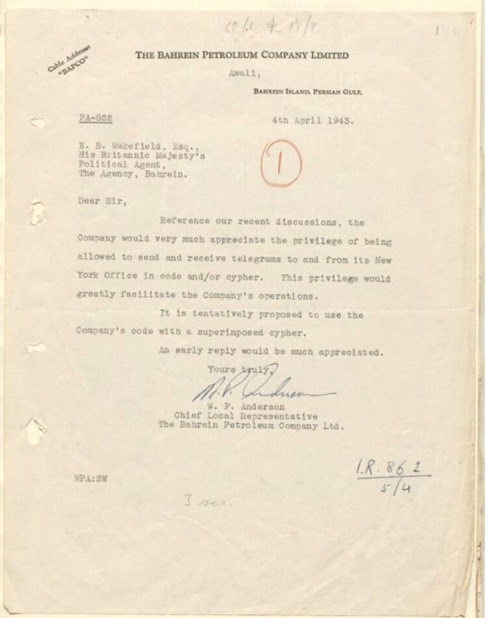

The Political Resident of the Persian Gulf in Camp Bahrain forwarded the request on April 8 to the Secretary of State for India in London, who approved the use of a secret code, provided that censorship received a plain text version of all messages, sent in that code, BAPCO should continue to send messages through the Navy if they contained vital information that would be of direct use to the enemy, and messages regarding political matters were to be sent through the Political Agent. After consulting the New York office, Ward Anderson agreed to these conditions.

P.A.I.C. in Baghdad asked whether the code had already been vetted for security. As this was not the case, the British Political Resident forwarded the request to SNOPG (Senior Naval Officer in the Persian Gulf) in Basra but they had no officer qualified to vet the code. Therefore, PAIFORCE suggested to vet the code.

The new code, proposed by the California Texas Oil Company, arrived from New York on October 24, and Bahrain forwarded the code on November 10 by courier for examination to the Cipher Security Officer of P.A.I.C. in Baghdad. After reviewing the code, the Security Officer responded that the code offered little resistance against cryptanalysis and provided no security whatsoever.

Note: P.A.I.C. (Persia and Iraq Command) in Baghdad was the headquarters of PAIFORCE (Persia and Iraq Force), the British and Commonwealth military formation in the Middle East from 1942 to 1943.


Surprised by this answer, Ward Anderson explained that the code was allocated by the U.S. Navy Department and considered the most secure known, used for the most secret messages. He clarified that "each page of the pad of sheets is used only once and destroyed after use". He continues, "In fact, the code changes with each succeeding letter of the message. When the pad is exhausted, a new set of pads is produced".

To Anderson, it seemed unlikely that British military authorities would be unfamiliar with the proper use of this type of code, so he asked to verify whether the code was indeed insecure, adding that U.S. authorities would be most interested if the British claims proved correct.

This was probably his polite way to hint the Political Agency and the PAIFORCE Security Officer that they were going to embarrass themselves. To their defense, it might be possible that the code was not accompanied with the complete and proper coding instructions, thus failing to show that the code was for one-time use.


Soon after, the Secretary of State for India in London informed the Political Resident in Bushire, Iran, that the U.S. Chief of Cable Censorship urgently requested permission to use the code, adding that it was a one-time pad, similar to the one used by the Ministry of War Transport in London. P.A.I.C. also received note of this. Apparently, someone pulled some strings.

Subsequently, the Political Resident confirmed to its agency in Bahrain that the code was indeed a one-time pad from the U.S. Navy Department. Eventually, the agent informed the BAPCO representative that objection to the code had been withdrawn and that "the one-time pad can be used on the understanding that the pad is not worked through more than once".


BAPCO started using the one-time pads as of January 15, 1944, more than eight months after their initial request. Yes, even during wartime, bureaucrats persist. Of course, we have to take in account that transportation and communication means in 1943 were quite different from today, and codes were always transferred safe-hand by courier.

Once the war had ended, BAPCO requested on August 22, 1945 permission from Bahrain to commence the use of the company's own cable code again, as used before the outbreak of hostilities in 1939.

Below one of the BAPCO coded messages from Bahrain to New York, with plain version included, submitted to Censorship as agreed with British authorities.


These archived conversations are a rare example of a commercial firm using the unbreakable one-time pad in the early 1940s. At that time, the use of such strong encryption was generally limited to governments, their military, intelligence agencies and diplomacy. BAPCO's use of one-time pads, allocated to them by the U.S. Navy Department, is a nice example of how government and commercial firms teamed up to ensure the highest level of communications security for those companies that were somehow important to the war effort.

All letters and cables regarding this request for using one-time pads are found in the British Library: India Office Records and Private Papers as File 10/5 BAPCO CODES, reference IOR/R/15/2/423. More examples of coded messages and their plain text version, submitted to censorship, are found in File 10/23 Code Messages - BAPCO, reference IOR/R/15/2/450. These records are archived in the Qatar Digital Library. More on the 1940 bombing raid on Bahrain in the Qatar Library, and an account of the attack on the BAPCO refinery is available at the Saudi Aramco website.

These documents are also unique as a reference, because the use of one-time pads is hardly mentioned in official documents from that era (for obvious security reasons) and they are, as far as I know, the earliest I came across. They confirm the use of one-time letter pads  by Political Residents of the British Imperial Civil Administration, the British Army, the Ministry of War Transport in London and the U.S. Navy, at least as early as 1943. Both British and U.S. authorities were quite familiar with the system and surprisingly even shared it with commercial firms. The archives also show that British Residents in the Middle East regularly received sets of two-way one-time pads.

More historical and technical information about one-time pad is available at my Cipher Machines and Cryptology website.

The Bahrain Petroleum Company (BAPCO), one of the oldest oil companies in the Middle East, was established in 1929 by Standard Oil Company of California. BAPCO obtained in 1930 the only oil concession in Bahrain. In 1936 they discovered the Awali oil field and opened a refinery with a capacity of 10,000 barrels per day. That same year, Standard Oil Company of California signed an agreement with Texaco, creating the joint venture California Texas Oil Company (Caltex). These companies are now known as Chevron and Texaco. The Bahrain government took over all BAPCO shares in 1980 and acquired full ownership in 1997. Visit their website to read  BAPCO's history.

Tuesday, December 09, 2014

Professor Brailsford on Enigma

Computerphile just published two talks by Professor Brailsford about the WW2 German Enigma cipher machine (edit: the third and final part is now published). He explains in an excellent and entertaining way how Enigma works and how it was broken, first by the Polish en then the British codebreakers in Bletchley Park. I believe it's one of the best videos I've seen on making codebreaking understandable. A must see! The talks are  made on the occasion of the release of The Imitation Game, a new movie about Alan Turing's work on Enigma. More detailed info on Enigma at these webpages.


Turing's Enigma Problem (Part 1) - Computerphile


Tackling Enigma (Turing's Enigma Problem Part 2) - Computerphile


Enigma, TypeX and Dad - Computerphile

Sunday, November 03, 2013

The Atomic Age - Black on White

Following up on my Camp Century post about the use of a small nuclear power reactor in Greenland, I would like to recommend two fascinating websites about atomic energy and nuclear weapons.

Mark's weblog Atomic Skies covers a wide range of applications of atomic energy. He presents both technical and historical facts, based on publicly available papers. Some of the installations, devices and ideas, conceived in the early years of atomic energy, were pretty amazing. This mysterious energy inside that tiny atom produced both some of the weirdest and some of the most brilliant inventions, from nuclear air planes to today's pretty secure nuclear reactors.


Alex Wellerstein is an historian of science at the American Institute of Physics. Alex is the author of the Nuclear Secrecy Blog and historical documents are his natural biotope. His work covers the complete nuclear era but focuses mainly on the development of the atom bomb during WW2 and the early Cold War years. He explains in an excellent way the military, technical, as well as the historical aspects of the bomb and the men who developed it.

Together, Atomic Skies and  Nuclear Secrecy Blog are good for countless hours of fascinating reading. Highly recommended

Saturday, March 23, 2013

OPERATION TURING

Story by Mitchel Thomas
Artwork by Indiana Popovich
In February, Mitchel Thomas and Indiana Popovich started a  unique project called OPERATION TURING. They are the first to blend a mysterious espionage story with the blistering pre-ware atmosphere of 1938 and encoded messages.

The British SIS, the American OSS and French DB have formed an Intelligence Task Force, code-named LABYRINTH, to identify the main threats to the Allies. Unfortunately, George Paxton, the original head of LABYRINTH, turned out to be a counter-intelligence agent of the German SS Sicherheitsdienst. One of the first priorities for the new head of LABYRINTH, SIS operative Peter Hansen, is to find Praxton and bring him to justice. Meanwhile, Paxton has his own agenda and forges some dark plans.

The story is cast into a weblog. After a brief introduction on OPERATION TURING, the reader is presented with various pieces of information: communications between the operatives by cable or radio, newspaper articles, photo's and Enigma encrypted messages. With each new blog post, a new bit of the hunt for Praxton and the battle between Allied and Nazi security services in unveiled.

Artwork by Indiana Popovich
The whole website breathes the atmosphere of shadowy operations in the pre-ware era. The images, black-and-white photos, old postcards, telegrams, maps and even 1938 PanAm flight tickets, combined with a beautiful art-deco background,  immerse you in that fascinating period at the brink of war.

I was pleasantly surprised to see a well brought and exciting story, where the Enigma messages play the smaller role, and not the other way around. Here, attention goes in the first place to the story-line, not to the tools to bring the story, and that's a great idea. Moreover, its a unique idea.

I can highly recommend a visit to OPERATION TURING, to absorb the story and atmosphere. Each new post brings new information in various forms. Often, there's and Enigma encrypted radio or cable message. The Enigma key sheets are provided and you can click your way to additional info and help. No codebreaking or cryptanalysis is needed, all settings to decipher the messages is provided.

However, being such a mysterious website, you should first continue reading here below, to understand how things work at OPERATION TURING. You might get lost in the fog of the shadowy world of intelligence and spies, when you're not 'in the picture'!

The newcomers on OPERATION TURING should first do some read-up before reading the episodes, published every few days. Warning: the most recent episode of the story is found first (weblog system). If you're new and want to start at the beginning of the story, you should go directly to the bottom of the main pages and click on the "=>Older" link your way through the blog pages to the oldest (first) message where the story begins.

There are three other pages that you can visit by links at the top of the page (under the green logo): You'll fist need a read-up at About Operation Turing to travel back to 1938 and to get familiar with the main characters. How to decode the messages provides the ways an tools to decipher the messages.

Transcripts and decoded messages is the spoiler page for those who really are unable to decrypt the messages (you should try, it's not that hard). However, only the decrypts of the previous month are provided. If you want to know right away how the story develops, you'll need to decipher the messages yourself. It does however pays off, as nothing beats the thrill of decoding a message and finally read its content. Finally, you can always go back to the main page by clicking the green logo (Enigma in circle).

Artwork by Indiana Popovich

I discovered the website by accident, as they linked to my Enigma software to enable decrypting some of the messages. However, the unique thing about OPERATION TURING is not the use of Enigma or some challenge to decipher encrypted messages. Enigma is merely a means to bring information to the reader. 

Mitchel and Indiana did a wonderful job on the story and the graphics. For the two friends, it all started years ago when they used coded messages to communicate, just for fun. A few years later, after graduation, they moved apart and brought the coded messages back to life to keep contact. To make thing interesting for themselves, they developed characters and a story-line which resulted in this jewel called OPERATION TURING.

I truly believe it deserves much more attention and readers than it was meant for. Their childhood pastime evolved into a unique and beautiful project. I'm sure Mitchel and Indiana will love your feedback (see their Inquiries link). Rendez-vous at the OPERATION TURING website... and watch your back!

A similar adventure is created at Cipher Machines and Cryptology. Operation Tinker Bell is the 1964 hunt for a KGB defector. Bookmark that page and get ready to track down your Cold War enemies!

Saturday, February 23, 2013

Enigma World Code Group

Ham radio operator Bruce Culp N7CLH just announced the launch of the Enigma World Code Group. The website is created for people who want to learn about the famous German World War II Enigma code machine and to use an Enigma simulator to exchange coded messages with other members and friends in the group.

Real Enigma cipher machines are very rare and expensive, found only in a few museums and in private collections. However, today, several fully compatible Enigma simulations are available as freeware download on the Internet. You can also use these simulators to decrypt authentic wartime messages, today available with the original message keys.

Using a WW II cipher machine to encrypt or decrypt messages sounds pretty complicated? Think again! Bruce and Terry Culp did an excellent job in creating a website that clearly explains step by step how to send Enigma encrypted messages.

Over time, more and more Enigma enthusiasts have started to send Enigma encrypted messages to each other: collectors do it for fun, students and teachers learn about Enigma at school and want to try it themselves, on U-boat computer game forums they communicate with each other during virtual U-boat missions, and anyone with a technical mindset loves the technology behind this ingenious machine. They all love to work with this fascinating piece of wartime cryto gear.

Thanks to the Enigma World Code Group (EWCG), you can now team up and send messages as if you were a German signals operator yourselve. You can generate your own code books or use EWCG's standard U-571 code books. Visit the Enigma World Code Group, join the group today and enter the world of WW2 encrypted radio messages! Fun guaranteed!

Saturday, October 27, 2012

Decrypted Intercepts from the Second World War

GC&CS in Bletchley Park
The National Archives (UK) has published a large file with fascinating intelligence from more than 500 intercepted and decrypted German, Italian and Japanese radio communications between 1941 to 1945. This is a unique release of historical significant information.

The messages, translated into English, originate from the duty officer of Hut 3 (translation, analysis and dispatch) in Bletchley Park, home of the Government Code and Cypher School (GC&CS) and the center of British codebreaking efforts during the Second World War.

The large scale interception, decoding and analysis of millions of encrypted radio and teletype messages was one of the best kept secrets of the war. All these intelligence reports were classified "MOST SECRET" or TOP SECRET ULTRA" and the information was used with extreme caution to protect its source.

The published documents contain a wide range of tactical and logistical information, situation reports, downed aircraft and casualties, interrogation of prisoners, details of meetings of the highest ranking military, situation in occupied countries, the failed assassination attempt on Hitler, theft of art, and much more.

Some decrypts even show grave violations of the Geneva conventions such as direct orders to execute prisoners of war. I'm sure that some of these decrypts helped to convict many high ranked officers during the Nuremberg trials after the war. An historical treasure of information and a must read!

You can download file DEFE 3/573 from the National Archives. Note that this is a large 166 MB pdf file that can take a while to download! I you want to sift through many other intercepted communications, please visit this link at the National Archives or use its search engine. More about the breaking of German Enigma machine traffic is found on my website.

Friday, August 10, 2012

U-534 Enigma M4 Messages Cracked

Enigma M4
I just received sensational news from Michael Hoerenberg. He succeeded in breaking 12 authentic Kriegsmarine messages, recovered from the German WW2 U-boat U-534, which were encrypted with the notorious four-rotor Enigma M4 cipher machine.

U-534 is one of the very few U-boats that were either salvaged or survived the war. U-534 was sunk in May 1945 by a British bomber. When she sank, she took with her the secret documents and equipment that were used to encrypt their communications. During the salvage of the U-boat, some of the original message sheets were recovered and preserved.

At this moment, Michael already managed to recover the key settings to 12 of the 59 available messages with his M4 WinEnigma (Turingbombe) and TBreaker software (and 112 CPU cores). Images of the original recovered message sheets and their plaintext version are published on his website.

The  breaking of these messages is fantastic news for the crypto community and Michael's achievement cannot be underestimated! Original messages, enciphered with the Kriegsmarine Enigma M4 (a much complexer encryption than the three-rotor machines of the Wehrmacht) are extremely rare and deciphered M4 messages are truly unique.

We are looking forward to the coming results of the codebreaking project. Please visit Michael's website Breaking German Navy Ciphers for more information about the codebreaking, the software and the recovered messages.

U-534 in Birkenhead, England, 2007

U-534 is currently displayed in the U-boat Story museum in Birkenhead, England. More about U-534 at U-boat Net. For more information about the Kriegsmarine Enigma cipher machine, visit the Enigma page on my website, where you can also download the popular freeware Enigma simulator (which can be used to decipher the original U-534 messages with the dicovered key setting).

Update 1: Michael also made available Kapitänleutnant Hartwig Looks' war diary of  U-264, containing the 25 November 1942 message that was solved in the M4 Message Breaking Project (see also M4 Project on my website).

Update 2: More sensational news from Michael. He managed to decipher the famous message, sent to all U-boats, that announced Great Admiral Dönitz as successor of Hitler (after his suicide) as new Fuhrer of the Reich. The original message form, ciphertext and decrypts are found at this page, and more info at the page Degarbling the Dönitz Message.


Below a video of a part of the exhibition of U-534 in Birkenhead, UK, which also shows one partially and one completely recovered Enigma machine. Notice how well preserved all artifacts are.