|
| ASA SIGINT truck at Czech border Source: ASA Det J Schneeberg Vets |
Signals intelligence (SIGINT) comprises communications intelligence (COMINT) and electronic intelligence (ELINT). The latter is the interception and analysis of various technical signals such as weapons systems, navigation and radar. ELINT was an important part of the Cold War and is today still an indispensable part of modern intelligence gathering and warfare.
The secrets behind the signals were often revealed, either by ELINT or HUMINT (Human Intelligence i.e. espionage). However, some signals remained unidentified for decades and even rose to the stardom of mysterious Cold War signals. Speculation about their purpose fueled the paranoia of that era. Occupying certain frequencies for use in case of war, or the notorious Dead Hand autonomous launch system for nuclear missiles that would initiate a launch when the mysterious signal interrupted. Eerie, but only speculations.
The secrets behind the signals were often revealed, either by ELINT or HUMINT (Human Intelligence i.e. espionage). However, some signals remained unidentified for decades and even rose to the stardom of mysterious Cold War signals. Speculation about their purpose fueled the paranoia of that era. Occupying certain frequencies for use in case of war, or the notorious Dead Hand autonomous launch system for nuclear missiles that would initiate a launch when the mysterious signal interrupted. Eerie, but only speculations.
Tracking Nukes
One of those mysterious signals was nicknamed Russian Woodpecker, with its characteristic repetitive tapping noise. The Woodpecker's annoying high-power signal - an estimated 10 Megawatt - switched between different frequencies and disrupted legitimate HF signals (3-30 MHz) from utility and amateur communications across the world. The signal first appeared in 1976 and continued until 1986. Only after the fall of the Soviet Union it was confirmed that the signal came from an over-the-horizon (OTH) radar, part of Soviet early warning system for ICBMs (intercontinental ballistic missiles, i.e.nukes).
 |
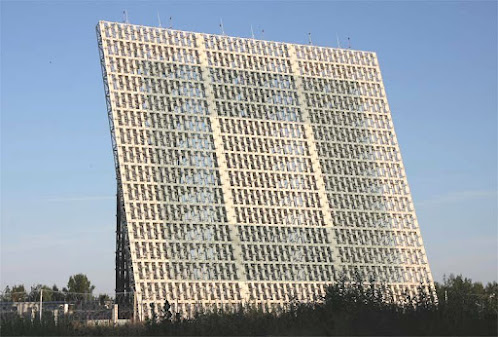
| Receiver antennas Chernobyl-2 site from the Duga-1 (source: Ingmar Runge) |
The Soviet Duga-1 OTH (Rus. Дуга-1 ЗГРЛС) comprised two military sites in the Ukrainian Soviet Socialist Republic (SSR). The Liubech-1 transmitter site near Kloniv, and 50 km southwest the Chernobyl-2 receiver site near Chernobyl. Both transmitter site and receiver site each had two giant antennas. The huge antenna for the lower HF frequencies (right on photo) was 450 m (1476 ft) wide and 150 m (492 ft) high. The "small" antenna for the higher HF frequencies (left) was 250 m (820 ft) wide and 90 m (295 ft) high.
Duga-1 became operational in 1976 and was directed over Greenland towards North America. The Chernobyl-2 site was codenamed STEEL YARD by Western military intelligence, who apparently managed to photograph the site during the Cold War.
 |
| Coverage Duga-1, 2 and N radars (Earth's northerly top view) |
The Duga-2 radar was located in the far east of the USSR, in the region Komsomolsk-on-Amur, with the transmitter in Lian and receiver in Bol'shaya Kartel, 50 km southeast of Lian. Duga-2 was directed over the North Pole towards Canada and North America. Note that the map shows the approximate coverage of the radars, not necessarily the actual reach, which depended on various conditions.
The Duga was designed to track ICBMs at 6-10.000 km (3400-6200 mi) and aircraft up to 3000 km (1865 mi). The actual range depended on the ionospheric conditions. They operated between 5 and 28 MHz, right on HF band (3-30 MHz), causing the strong interference. The huge antennas were phased array antennas where the beam could be directed electronically without any moving parts. The received signals were processed digitally.
Peeking Beyond the Horizon
Most radar waves (30 MHz up to 300 GHz) go straight ahead. Radar therefore works line-of-sight (LOS) and the curvature of the Earth limits its range. You can't look beyond the horizon, only above it. If the Duga with its 150 m (492 ft) high antenna was a normal LOS radar, it's horizon was a mere 44 Km (27 mi) away, since the distance to its horizon in kilometer = √ 13 x 150 m (for miles use 1.5 x ft).
Therefore, the further an ICBM or nuclear bomber is, the higher it must fly or the closer it must get to become visible above the radar's horizon, and that's way too long after its launch. LOS radar was therefore insufficient to provide early warning in case of an attack against the Soviet Union.
The solution to this problem was the over-the-horizon radar station. In Russian, Загоризо́нтная радиолокационная станция (ЗГРЛС) i.e. Zagorizóntnaya radiolokatsionnaya stantsiya (ZGRLS).
Therefore, the further an ICBM or nuclear bomber is, the higher it must fly or the closer it must get to become visible above the radar's horizon, and that's way too long after its launch. LOS radar was therefore insufficient to provide early warning in case of an attack against the Soviet Union.
The solution to this problem was the over-the-horizon radar station. In Russian, Загоризо́нтная радиолокационная станция (ЗГРЛС) i.e. Zagorizóntnaya radiolokatsionnaya stantsiya (ZGRLS).
 |
| Over-the-horizon radar principle |
When the OTH signal hits a moving ICBM, the reflected signal creates a small frequency shift (Doppler effect) as any radar does. However, only a very small portion, called backscatter, is reflected back by the ionosphere and effectively received by the OTH station. Complex digital processing is required to extract and analyse the very weak signal and the effect of the ionosphere and skips on the backscatter. Its accuracy and resolution are low, but the system works good enough for a raw early warning.
Disaster and Downfall of Duga- 1
Noteworthy is that the Duga-1 receiver site Chernobyl-2 is located only 10 km (6 mi) from the Chernobyl nuclear power plant. According to Vladimir Musiyets, former Commander Chernobyl-2, the installation was damaged during the 1986 Chernobyl disaster and never became operational again. The site now lays within the 30 km (18 mi) Chernobyl exclusion zone. Some sources state that the Woodpecker continued broadcasting until 1989. These reportings possibly refer to other OTH sites.
On the history of over-the-horizon radar (translation) by Yuri Davydov, chief designer OTH radar, details the history and technical aspects of the Duga radars. The Ukrainian Chernobyl -2: the secret twin of the city Chernobyl (translation) from the exclusion zone website has a short history and photos. Global Security also has details on the Duga stations. Radartutorial explains phased array antennas for radar, but if you're not that technical, watch Duga Radar - How it Works.
On the history of over-the-horizon radar (translation) by Yuri Davydov, chief designer OTH radar, details the history and technical aspects of the Duga radars. The Ukrainian Chernobyl -2: the secret twin of the city Chernobyl (translation) from the exclusion zone website has a short history and photos. Global Security also has details on the Duga stations. Radartutorial explains phased array antennas for radar, but if you're not that technical, watch Duga Radar - How it Works.
Chernobyl 35 Years Later has excellent photos of the Duga-1 antenna, the control station and its consoles. To get a good sense of the sheer size of the Duga-1 antennas, visit English Russia and check the 14th photo with people underneath the antenna. Many more photos at Lost Places and Egorka's gallery.
Note: The following video mistakenly states "Duga-3 alias Chernobyl 2". The Chernobyl-2 receiver in this video was, together with the Liubech-1 transmitter, part of Duga-1. There was never a Duga-3.
The
mistakes about the different Duga radars are understandable, as each
Duga had two separate sites, one transmitter and one receiver site, and
the site numbers didn't match the unrelated Duga number.
Note: The following video mistakenly states "Duga-3 alias Chernobyl 2". The Chernobyl-2 receiver in this video was, together with the Liubech-1 transmitter, part of Duga-1. There was never a Duga-3.
Note: The BBC video mistakenly translated site "Chernobyl-2" into system "Duga-2", although Sergei Babakov in the interview correctly said
"Чернобыль-2", which is part of Duga-1. Duga-2 was in the Far East, 9000 Km from Chernobyl. The video title should be Duga-1.
Substitutes for the Duga System
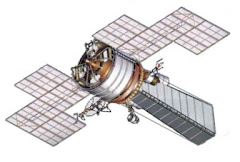
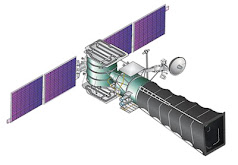
By the mid-1980s it became clear that the computer technology, used for the Duga phased array radars, was insufficient. However, the 1972 Око program for early warning satellites resulted in the first-generation US-K and US-KS satellites, operational in 1982 and the Око-1 program with second generation УС-КMO satellites in 1991. From 2015 on, these satellites were replaced by satellites of the Unified Space Detection System and Combat Control system.
In 2005 the Russian Federation also started to build a new generation of phased array radars for early warning, called Voronezh. Seven of these radars are already operational across Russia. More detailed info at Russia's Modern Early Warning Systems.
Buzzing Air and Messages for Spies
Another famous mysterious Soviet signal is known under its call-sign UVB-76. The station, nicknamed The Buzzer, started in 1982 with a two-seconds beep tone and switched after a decade of operation to a monotonous 25 buzz tones per minute, every single day. The station was extensively observed by radio amateurs (without doubt an equally monotonous job) and only a handful of voice conversations were recorded in its 28 years of operation.
Its call-sign UVB-76 was revealed during one of its rare voice conversations. The purpose of The Buzzer remains unknown until today. UVB-76 stopped broadcasting in August 2010 and remains silent since then. The transmitter site is located near Povarovo, 40 km (25 mi) north-west of Moscow, and now appears abandoned.
The UVB-76 "Buzzer" at Numbers Stations Research and Information Center, including some rare voice recordings. Photos of the abandoned alleged Buzzer site are published on English Russia.
Another true Cold War icon are the notorious Numbers stations. The stations broadcast streams of numbers or letters in voice or Morse and are used by intelligence agencies to communicate with their agents, operating abroad. Although the Cold War officially ended, there are still many active numbers stations and new keep popping up.
Further Information about SIGINT on the Blog
- Tracking Cold War Signals Wullenweber FLR-9 antenna
- 3 Second from World War 3 Early warning going wrong
- Russia's Modern Early Warning Systems
- OXCART and ELINT Research Stealth for A-12 and SR-71
- Silent Warriors, USAF C-130 downing in Soviet airspace
- USS Pueblo Incident Capture SIGINT ship by North Korea
- Numbers Stations and many related spy cases on the blog
- More posts about signals intelligence
More About SIGINT on the Website
Cold War Signals details the SIGINT battle during the Cold War. You can listen to many audio samples of signals from spy transmitter and international shortwave broadcast stations.
Numbers Stations explains the origins of these broadcasts, their purpose, who uses them and their encrypted messages. Also many documents of the spies cases that involved numbers stations.